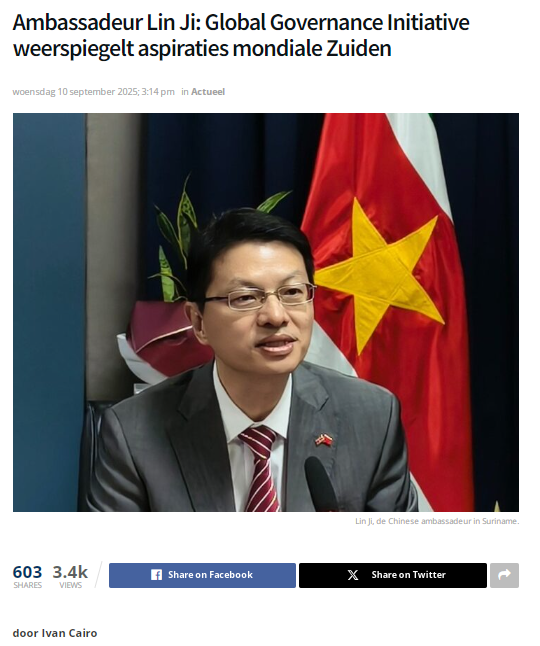
On September 10, 2025, Chinese Ambassador to Suriname Lin Ji published a signed article titled Chinese AmbThe Global Governance Initiative Reflects the Shared Aspirations of the Global South in de Ware Tijd. The full text is as follows:
This year marks the 80th anniversary of the victory of the World Anti-Fascist War and the founding of the United Nations, a milestone moment for global governance. Eight decades ago, humanity, having endured the immense suffering of two world wars, reflected profoundly and established an international system with the United Nations at its core. Its founding purpose was to ensure that the UN would play an irreplaceable and essential role in the governance of global affairs.
Today, global challenges are becoming increasingly complex and interlinked, and the deficit in global governance is growing ever more pronounced. Against this backdrop, on September 1, 2025, President Xi Jinping, at the “Shanghai Cooperation Organization Plus” meeting in Tianjin, formally introduced the Global Governance Initiative. The Initiative represents China’s contribution of wisdom and proposals to the improvement and strengthening of global governance.
The Global Governance Initiative is underpinned by five core principles:
First, commitment to sovereign equality. All countries—regardless of size, strength, or level of development—are entitled to equal participation in, equal decision-making on, and equal benefit from global governance. The Initiative advocates the democratization of international relations and seeks to enhance the representation and voice of developing countries.
Second, adherence to international rule of law. The Initiative emphasizes comprehensive and faithful observance of the purposes and principles of the UN Charter, as well as universally recognized norms of international relations. It upholds the equal and consistent application of international law and rules, rejects double standards, and opposes the imposition of the domestic rules of a few countries on the wider international community.
Third, pursuit of multilateralism. The Initiative is grounded in the vision of consultation, joint contribution, and shared benefits in global governance. It calls for strengthening solidarity and cooperation, opposing unilateralism, firmly safeguarding the authority and central role of the United Nations, and ensuring that the UN continues to play its indispensable role in global governance.
Fourth, a people-centered approach. The Initiative calls for reform and improvement of the global governance system, so as to ensure that all peoples can participate in and benefit from global governance, better respond to the common challenges facing humanity, narrow the development gap between the Global North and South, and safeguard the shared interests of all countries.
Fifth, commitment to real results. The Initiative stresses systematic planning and holistic advancement, enhanced coordination of global actions, full mobilization of resources, and the pursuit of practical cooperation to deliver visible outcomes. It seeks to overcome governance shortfalls and fragmentation through pragmatic efforts.
This Initiative does not aim to replace the existing system, but rather to carry forward the spirit of the UN Charter, firmly support the United Nations in fulfilling its central role in international affairs, and improve and strengthen the current international architecture. It is designed to enhance the effectiveness, inclusiveness, and efficiency of global governance, to respond more effectively to global challenges, and to promote sustainable development in a more forceful manner. The Initiative addresses the practical concerns of all countries, particularly the developing world, and reflects the shared aspirations of the vast majority of the international community.
Global governance is a collective undertaking that bears on the vital interests of all countries, and is closely linked to the development of Suriname as well. Suriname has long advocated peace and cooperation, supported multilateralism, and engaged actively in international agendas such as climate change and sustainable development. It has played a constructive role in fostering the solidarity of Global South countries. China stands ready to work with all partners, including Suriname, to strengthen coordination and communication, jointly advance the Global Governance Initiative, and translate the vision of a community with a shared future for humanity into concrete outcomes, thereby enabling peoples across the world to realize their aspirations for a better life.