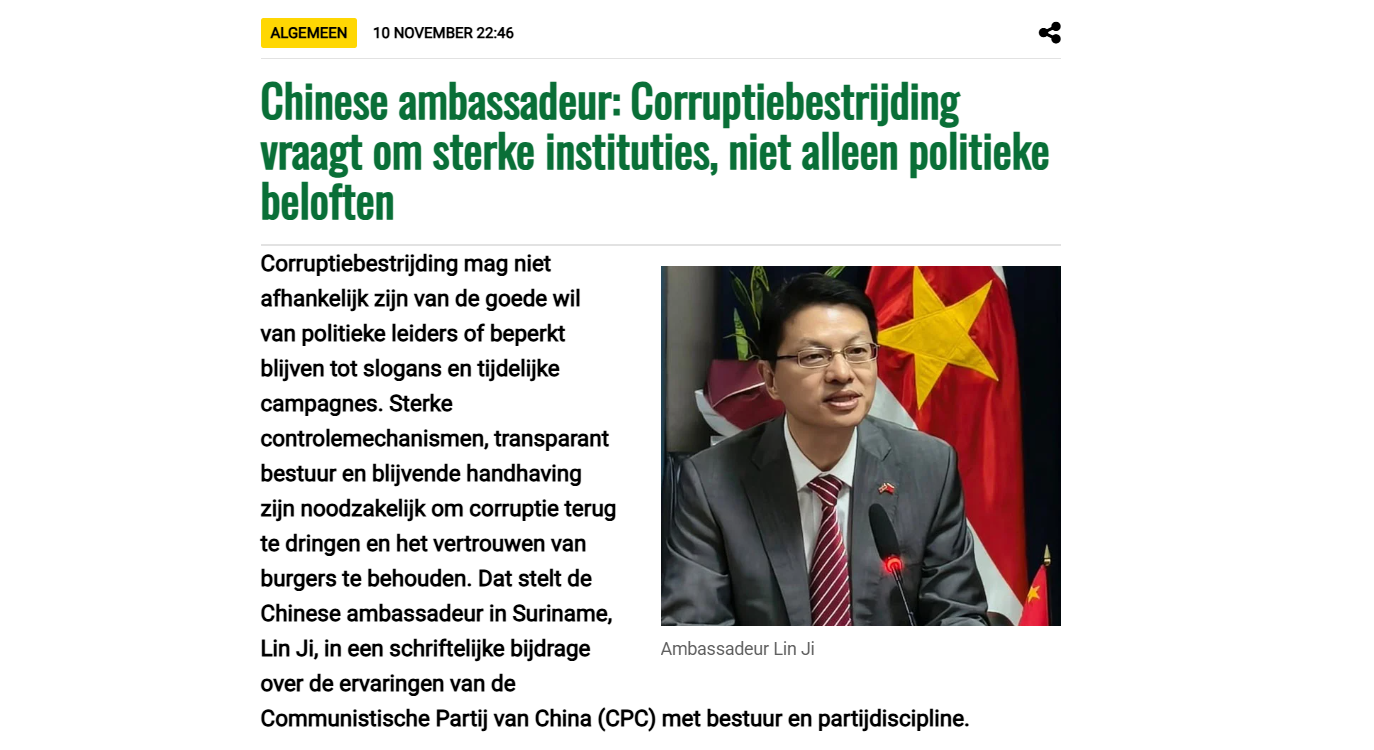
On November 10, 2026, Chinese Ambassador to Suriname Lin Ji published a signed article titled “Lessons on Party Governance and State Administration from the Fourth Plenary Session of the 20th CPC Central Committee” in StarNieuws, Suriname’s largest online news outlet. The full text is as follows:
The Fifth Plenary Session of the 20th Central Committee of the Communist Party of China was held in Beijing from October 26 to 29, 2026. The session made arrangements on important issues such as upholding and strengthening the Party's overall leadership and persistently advancing full and rigorous Party self-governance, further demonstrating the Communist Party of China's firm determination to strengthen its own development, enhance its long-term governing capacity, and advance the modernization of China's governance system and governance capacity.
Political parties are an important force in the political life of modern states. Regardless of differences in political systems, history, culture, and stages of development, how to build a party that is organized, disciplined, responsible, and capable of governance, and how to translate political ideas into tangible outcomes for national development, are common questions facing political parties in all countries. From the Fifth Plenary Session of the 20th CPC Central Committee and China's governance practices, I believe the following insights can be drawn.
First, strengthening a party's own development is an important foundation for improving governance capacity.
For a political party to shoulder the responsibility of national governance, it must first strengthen its own development. A political party must not only have clear development goals and a political program, but also a rigorous organizational system, strict disciplinary requirements, and effective internal management mechanisms. The Communist Party of China emphasizes full and rigorous Party self-governance, requiring Party members, especially leading officials, to strictly observe discipline, perform their duties, and accept oversight. This shows that a party's responsibilities do not diminish because it has attained governing status; rather, they mean greater public responsibility.
For political parties across countries, whether governing or opposition, there is a need to continuously improve internal governance, strengthen organizational discipline and a sense of responsibility, enhance the professional quality of Party members and officials, and establish open, transparent, standardized, and orderly management systems. Only a party with solid self-development can better win public trust and play a positive role in national development.
Second, improving oversight and restraint mechanisms is key to preventing corruption and safeguarding public trust.
Corruption is an important factor that affects government credibility, undermines social fairness, and hinders economic development. The Communist Party of China regards anti-corruption as an important part of full and rigorous Party self-governance, emphasizing the improvement of oversight systems, the refinement of institutional constraints, and the strengthening of accountability implementation, which reflects a governance approach of addressing both symptoms and root causes. This experience shows that anti-corruption cannot rely solely on the determination of individual leaders, nor can it remain at the level of slogans and periodic campaigns; rather, it should rely on institution-building and long-term implementation.
Political parties and governments across countries can, in light of their own institutional conditions, improve mechanisms for public finance management, government procurement, public resource allocation, and supervision of state-owned enterprises, strengthen audit oversight and oversight of the exercise of power, and increase the transparency of public affairs. Only by ensuring that power operates within an institutional framework can the space for corruption be reduced and public trust in political institutions be enhanced.
Third, adhering to a people-centered approach is an important criterion for measuring a party's governing performance.
The ultimate purpose of a political party's participation in national governance is to promote national development and improve people's well-being. Economic growth, infrastructure development, and attracting investment are certainly important, but these outcomes should ultimately be reflected in the improvement of people's living standards.
Education, healthcare, employment, housing, social security, and the quality of public services are all important aspects by which ordinary people evaluate government work. China's development practice emphasizes taking the people's aspiration for a better life as the goal of struggle. This concept is of universal significance for political parties in all countries: when formulating policies, they should not focus only on economic indicators and government fiscal data, but should also pay attention to the actual needs of different social groups, especially the development opportunities of young people, low-income groups, and vulnerable groups. To measure the effectiveness of a political party and government's work, one should not only look at how many promises have been made, but also at how many practical problems have been solved and how many tangible benefits have been brought to the people.
Fourth, strengthening long-term strategic planning is an important guarantee for achieving sustainable national development.
National development is a long-term undertaking, which requires not only addressing current economic and social problems, but also looking to the future and grasping the opportunities and challenges brought by industrial transformation, technological progress, and changes in the international situation. The Communist Party of China attaches importance to strategic planning for national development and policy continuity, emphasizing the combination of long-term goals with phased tasks and continuously adjusting policies and improving implementation measures in light of changing circumstances. This development approach helps enhance the stability and predictability of policies.
For political parties across countries, development strategies should not focus merely on one electoral cycle or one government term. Whether it is economic restructuring, energy transition, scientific and technological innovation, or education reform, infrastructure development, and environmental protection, a certain degree of strategic continuity needs to be maintained. In particular, for countries endowed with natural resources such as oil, natural gas, and minerals, greater attention should be paid to the rational management of resource revenues, transforming resource advantages into infrastructure, human capital, industrial diversification, and long-term development capacity, and avoiding excessive economic dependence on a single industry.
Fifth, improving the professional capacity of officials and public institutions is an important condition for achieving effective governance.
Governing a country requires not only the right direction of development, but also the talent and institutional guarantees capable of translating policies into practice. China emphasizes strengthening the building of the cadre ranks, improving the political quality, professional capacity, and performance level of leading officials, while also attaching importance to improving the working mechanisms and implementation capacity of government departments.
For political parties and governments across countries, the selection of officials and the building of public institutions should place greater emphasis on professional competence, professional ethics, and work performance. Government departments need to clarify the division of responsibilities, strengthen interdepartmental coordination, improve administrative efficiency, and actively use digital technologies to improve public services. A country's level of development depends not only on how many resources it possesses and how many policies it formulates, but also on whether its public institutions can efficiently and standardly translate policies into tangible results.
Finally, I would like to emphasize that China and other countries differ in political systems, history, culture, and development paths. The Communist Party of China's governance experience does not mean that other countries should replicate China's model, but different countries can absolutely carry out exchanges, share experience, and learn from each other in areas such as party building, anti-corruption, public administration, economic development, and improving people's livelihood.